Strategic, Powerful Treatments

For patients who have used standard topical hair loss products without achieving satisfactory results, prescription-strength formulations offer a clinically grounded escalation. At the Canadian Hair Transplant Centre, our licensed nurse practitioners assess candidacy for prescription-strength topical treatments as part of a broader, individually designed hair loss management plan.

Why Do Some Patients Require Prescription-Strength Treatments?

Standard over-the-counter topical products are formulated for general use at concentrations that suit most patients, but they’re not effective for everyone. Some patients experience insufficient absorption due to scalp characteristics, inadequate response to standard concentrations despite consistent use, or a pattern of hair loss that requires a more targeted approach. Prescription-strength topical formulations address these gaps by delivering higher-potency active ingredients directly to the follicular level under clinical supervision.

Doctor media

Why Choose the Canadian Hair Transplant Centre?

Prescription-strength topical formulations require proper clinical assessment before being given to patients, since higher concentrations have a different tolerability and side-effect profile than over-the-counter alternatives. Our nurses supervise all prescription topical therapies in accordance with International Society of Hair Restoration Surgery (ISHRS) protocols, with decisions informed by trichoscopic assessment and a thorough review of your treatment history. They work alongside our founder, Dr. Sharma, to ensure every treatment regimen is medically sound and grounded in proven results.

The Canadian Hair Transplant Centre is the only practice in Alberta dedicated exclusively to hair restoration, with a fully operational clinic. Our location is a CPSA-approved Non-Hospital Surgical Facility, ensuring prescription therapies are managed within a properly credentialed clinical environment with structured monitoring.

Doctor background

Schedule A Consultation

What to Expect From Your Prescription-Strength Topical Treatments in Edmonton

Aligning Treatments With Your Scalp Response

Our nurses only consider prescription-strength topical formulations for patients who meet specific clinical criteria after trying standard over-the-counter products. They’ll conduct a confidential assessment to confirm that escalation is clinically warranted before issuing a prescription. They’ll focus on the following factors during your evaluation:

  • A documented history of consistent over-the-counter topical use over at least one year
  • TrichoScan imaging that confirms ongoing progressive thinning in areas where standard topical products were applied correctly
  • Scalp characteristics, including absorption barriers such as seborrhoea or localised inflammation, that may have reduced the effectiveness of standard-concentration products
  • Treatment history, including any reactions to ingredients in standard formulations 

Prescription-Strength Topical Finasteride

Prescription-strength topical finasteride delivers dihydrotestosterone (DHT) suppression directly to the scalp at concentrations higher than those found in commercially available preparations. Because the medication is applied topically rather than ingested, absorption into the systemic circulation is substantially lower than with the oral tablet. Our nurse practitioners will determine the appropriate concentration and application protocol based on your individual scalp assessment and treatment history.

Prescription-Strength Topical Minoxidil

If standard 2% or 5% minoxidil concentrations have not produced adequate results, prescription-strength topical minoxidil offers a higher-potency alternative. This formulation is applied to the scalp in the same twice-daily manner as standard minoxidil but delivers a stronger vasodilatory effect to the follicular environment. We apply the following considerations during prescription-strength minoxidil assessments at our clinic:

  • Confirmation that standard concentrations were applied correctly and consistently
  • Assessment of scalp tolerability, since higher concentrations carry an increased risk of local irritation, dryness, and unwanted contact-transfer hair growth
  • Review of any cardiovascular history that may be relevant when using higher-potency vasodilatory agents 
  • Determination of whether a foam or solution vehicle is more appropriate based on individual scalp sensitivity and prior product tolerability

Combination Prescription Topical Formulations

Some patients benefit most from a prescription topical formulation that combines multiple active ingredients in a single application. These combination formulations may include higher-potency minoxidil alongside topical finasteride, tretinoin to enhance penetration, or other physician-selected agents in a single compounded preparation. Dr. Sharma and our nurses will assess whether a combination prescription topical is more appropriate than individual higher-potency products based on the following:

  • Your specific hair loss pattern and distribution
  • Your prior response to individual active ingredients used separately
  • Scalp health and the capacity of the follicular environment to absorb a multi-ingredient preparation
  • Your preference for a simplified application, and whether combining agents reduces the risk of inconsistent use
Background media
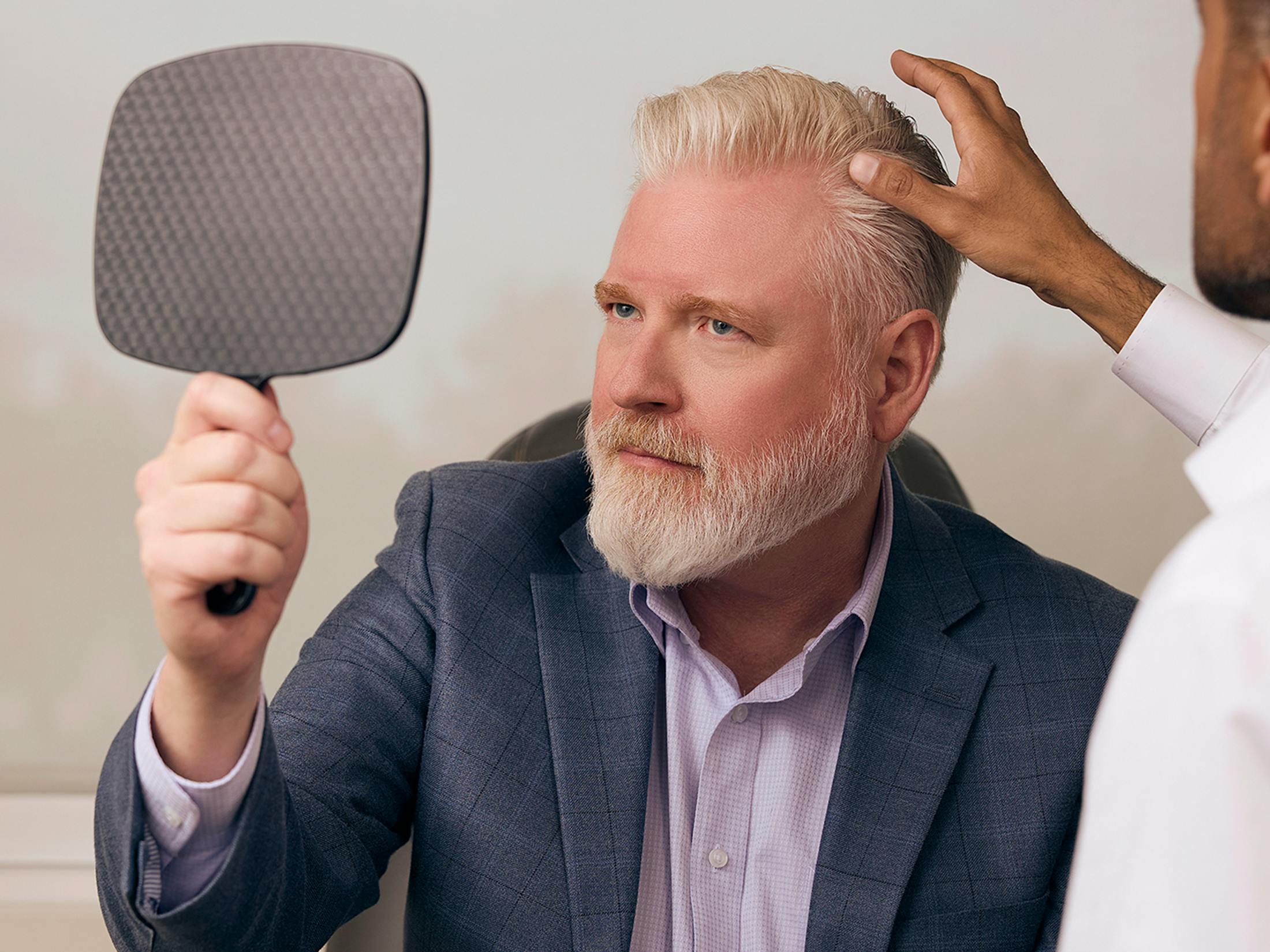
A man looking in the mirror

Dosing and Side Effects

Prescription-strength topical formulations are applied according to a specific dosing protocol determined by our nurse practitioners. Most formulations are applied once or twice daily, depending on the active ingredients. Higher concentrations carry an elevated risk of the side effects associated with their standard counterparts, including scalp dryness, irritation, and, in some cases, localised redness or flaking.

Your Follow-Up Process

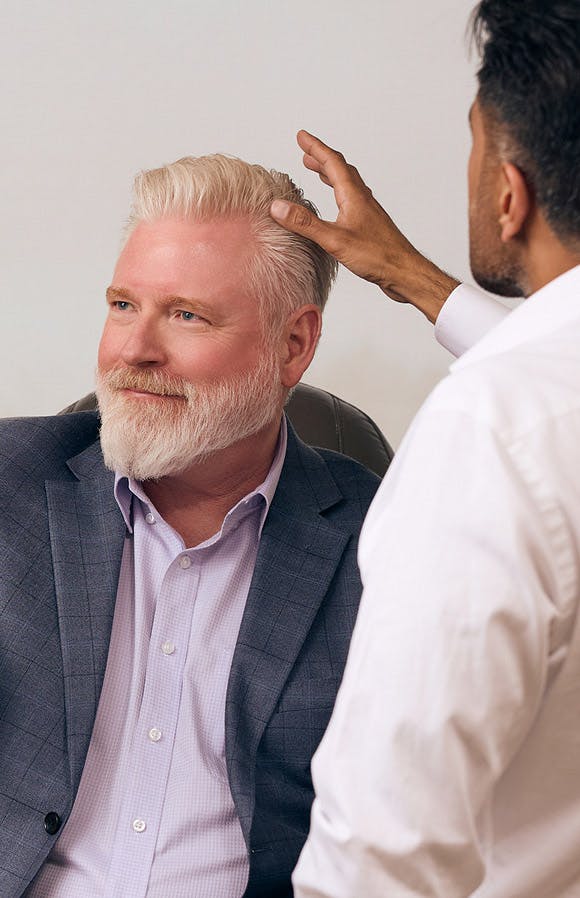
After starting a prescription-strength topical formulation, our team of nurse practitioners will provide structured follow-up appointments to assess your response and monitor for adverse effects. Your follow-up process may include the following:

  • Review appointments at three, six, and 12 months to evaluate treatment response and tolerability
  • Guidance on integrating prescription topical therapy with complementary treatments such as microneedling, PRP, or oral medications
  • Clinical photography to document visible changes in coverage 
  • TrichoScan assessments to measure changes in follicular density and hair shaft diameter 
  • Assessment of any side effects and a review of whether the current formulation, concentration, or vehicle base remains appropriate
  • Discussion of whether ongoing escalation, de-escalation, or a change in formulation is warranted 

Our team is available between appointments at our clinic if questions or concerns arise during the early months of your treatment.

Gradual, Powerful Results

Most patients who respond to prescription-strength topical formulations notice a reduction in shedding within the first three to four months, with visible improvements in follicular density and hair shaft quality becoming apparent between months six and 12. Because these formulations contain higher-potency active ingredients than standard products, some patients who did not respond to over-the-counter alternatives achieve measurable improvements with consistent prescription-supervised use over an 18-month period.

man smiling

Prescription-Strength Topical Formulations Frequently Asked Questions

Are prescription-strength topical formulations available to all patients?

Yes, but only with a documented history of consistent use of standard-concentration formulations. Higher-potency options are most appropriate when a genuine treatment gap has been identified. Exceptions may be made when clinical assessment suggests that standard concentrations are unlikely to be effective from the outset.

Is topical finasteride at prescription strength as effective as oral finasteride?

Evidence suggests that prescription-strength topical finasteride can achieve meaningful localised DHT suppression, though the extent of systemic DHT reduction is lower than with the oral tablet. For patients whose primary concern is oral finasteride’s side effects, the topical route offers a reasonable alternative. Our team will discuss expected outcomes in the context of your specific situation.

Can prescription-strength topical treatments be used alongside surgical hair restoration?

Yes. Prescription topical formulations are frequently used both before and after hair transplant surgery to support the health of non-transplanted native hair. Our nurse practitioners will advise on appropriate timing and any adjustments to application protocols around the surgical period to ensure compatibility with your treatment plan.

How do I know if my lack of response to standard topical products is due to concentration or to something else?

This will be determined during your clinical assessment. Inadequate response to topical treatments can result from poor absorption, incorrect application, an underlying inflammatory scalp condition, or a more advanced stage of hair loss than topical therapy alone can address. TrichoScan imaging and a thorough review of your treatment history will help clarify the most likely explanation before any prescription decision is made.

Schedule Your Surgical Consultation

Hair transplant surgery requires careful evaluation and planning. Schedule a consultation to determine if you are a candidate for FUE or FUT procedures. The assessment includes donor evaluation, recipient area analysis, and discussion of realistic outcomes based on your individual characteristics. For medical therapy options, consult with your primary physician or dermatologist.

Contact us media Contact us media
Accessibility: If you are vision-impaired or have some other disability covered by the Accessible Canada Act, provincial accessibility or human rights legislation, or a similar law, and you wish to discuss potential accommodations related to using this website, please contact our Accessibility Manager at (780) 476-7970.
Book Consultation