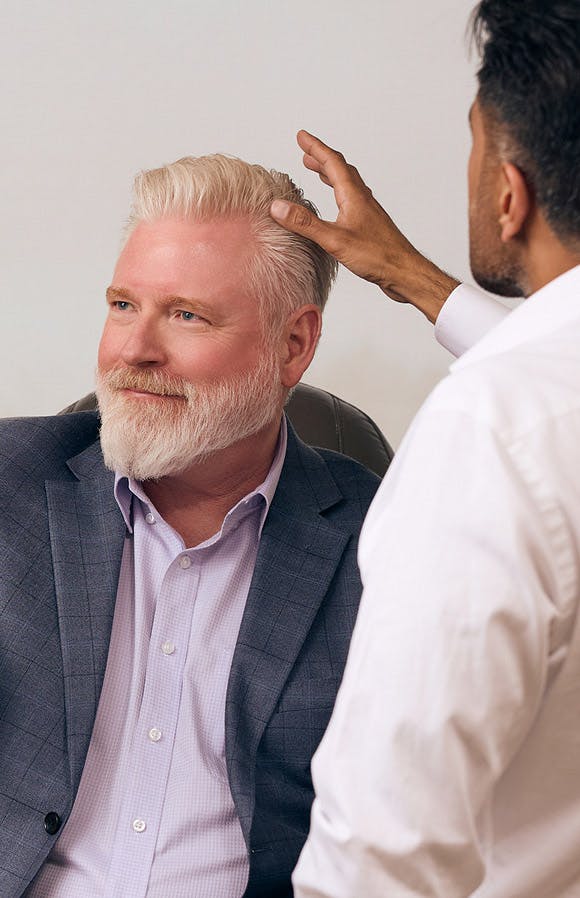
A high hairline or an oversized forehead isn't always something a hair transplant alone can fix. For patients whose forehead height is disproportionate to the rest of their face, Hairline Lowering and Forehead Reduction surgery repositions the hairline itself, rather than simply adding density behind it. This procedure is planned and performed by Dr. Anil Sharma, often as the first stage in a longer-term hairline design plan.
Hairline Lowering & Forehead Reduction in Edmonton







Understanding the Procedure
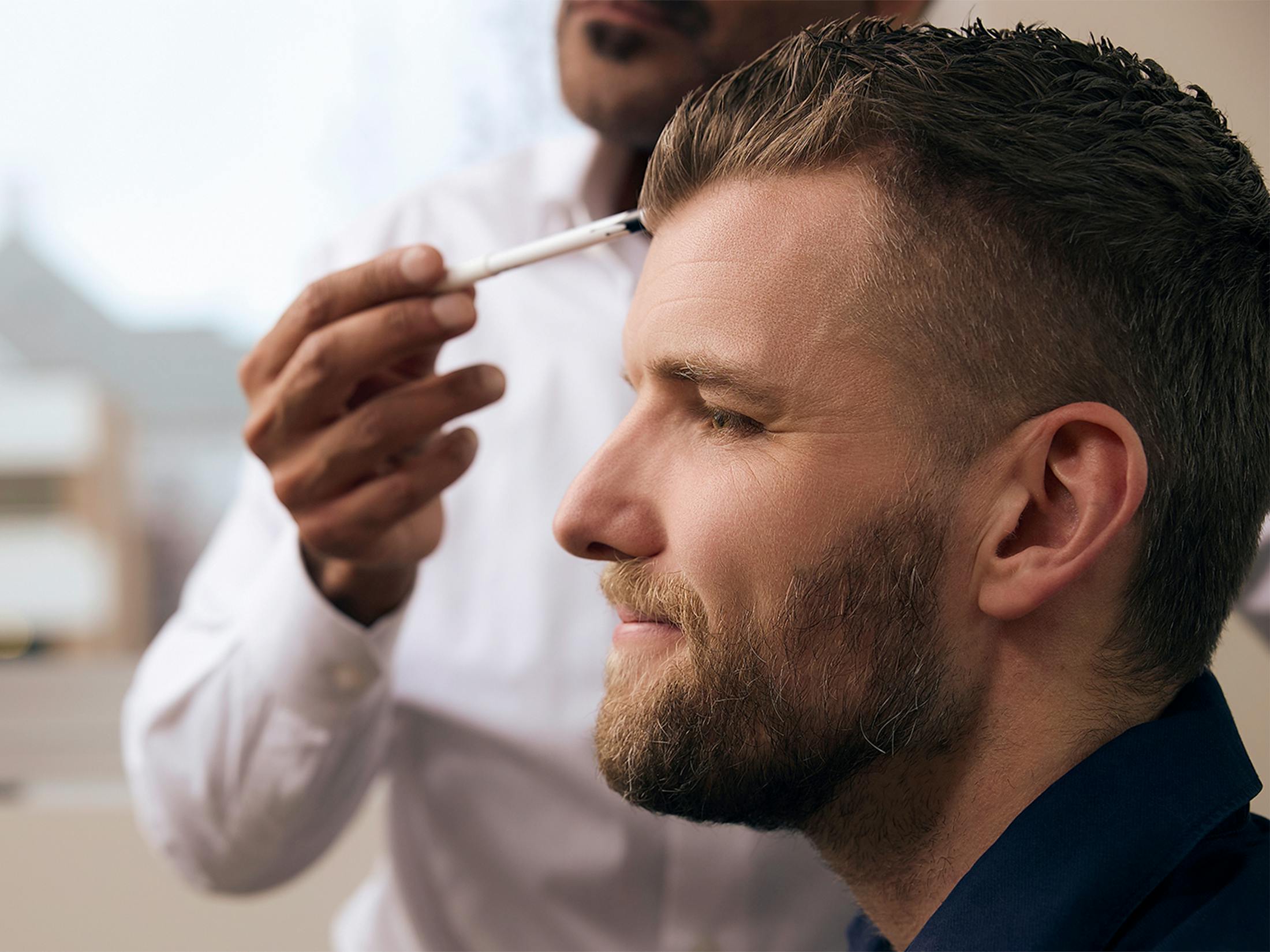
Hairline Lowering, also called Forehead Reduction, is a surgical advancement of the scalp. Dr. Sharma removes a strip of forehead skin just below the existing hairline, then releases and advances the scalp forward so hair-bearing skin sits closer to the eyebrows. The incision is closed along the new hairline using a trichophytic technique, meaning the edges are bevelled so hair can eventually grow directly through the resulting scar line, rather than leaving a visible bald seam. This is a different category of procedure from FUE. No follicles are extracted or relocated; instead, existing hair-bearing scalp is physically moved forward. Because of this, Hairline Lowering suits a specific kind of patient: someone whose forehead is proportionally large due to scalp position, not someone whose primary concern is thinning or diffuse loss.
Who This Procedure Is For
Candidacy depends heavily on scalp laxity: how much the skin of your scalp can stretch and move forward without excessive tension on the closure. Most candidates can expect a reduction of somewhere between 1.5 and 5 centimetres in a single procedure, depending on laxity. Larger reductions may require a staged approach using tissue expansion beforehand, which Dr. Sharma will discuss if your case calls for it. During your consultation, Dr. Sharma assesses:
- Forehead height relative to your other facial proportions
- Scalp elasticity and how much advancement your tissue can safely tolerate
- Whether your hairline recession is due to position (correctable surgically) or pattern loss (better suited to FUE)
- Skin and scar healing history, since trichophytic closure quality depends on how your tissue heals


The Canadian Hair Transplant Centre Difference
Forehead reduction is a less commonly performed procedure than FUE, and outcomes vary considerably based on surgical experience with scalp advancement specifically. Dr. Sharma performs every marking, incision, and closure personally, and plans each case around your individual scalp laxity rather than a standardised reduction amount. Our facility is approved by the College of Physicians and Surgeons of Alberta (CPSA), and our surgical protocols align with the standards of the International Society of Hair Restoration Surgery (ISHRS). Dr. Sharma is CPSA-licensed and trained in France, Italy, and the UK.

Recovery
Swelling is the dominant feature of the first week, and it's often more pronounced than what patients expect from FUE, sometimes extending down toward the eyes for a few days before settling. Numbness along and behind the hairline is common and typically improves gradually over several months as sensation returns. Most patients take one to two weeks away from work, longer than a typical FUE recovery, due to swelling and the visibility of the healing incision line before hair growth begins to cover it. Strenuous activity, bending forward, and anything that raises blood pressure in the head should be avoided for at least two weeks.
Schedule A Consultation

What Results Look Like Over Time
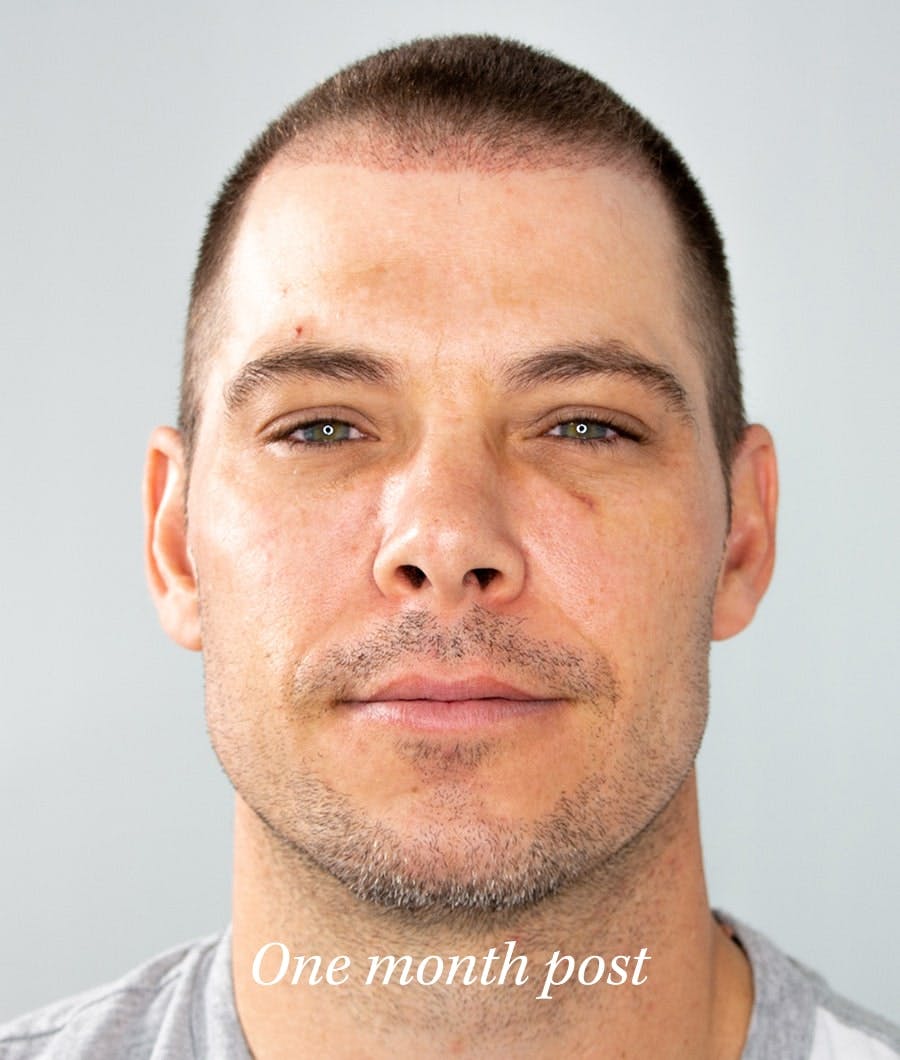
The positional change from Hairline Lowering is immediate, once swelling resolves over two to four weeks. Hair growth through the trichophytic scar takes longer, generally becoming visible by four to six months and continuing to fill in for up to a year. If FUE finishing work is planned, those grafts follow the standard transplant timeline of three to eighteen months for full maturation.

Hairline Lowering & Forehead Reduction Frequently Asked Questions
How is this different from a hair transplant?
A hair transplant relocates individual follicles to fill in thinning areas. Hairline Lowering moves your existing hair-bearing scalp forward as a single unit, changing the position of your hairline rather than its density. The two procedures solve different problems and are sometimes used together.
Will there be a visible scar?
There will be a scar, but the trichophytic closure technique is designed so hair grows through it over time, making it far less noticeable than a standard linear scar. How well hair grows through it depends on individual healing and scalp characteristics, which Dr. Sharma will discuss based on your skin type and history.
How much can my hairline actually be lowered?
This depends on your scalp's natural elasticity, typically somewhere between 1.5 and 5 centimetres in one procedure. Dr. Sharma determines your specific range during a hands-on assessment, since pushing beyond what your tissue can tolerate compromises both the closure and hair growth through it.
Is the numbness permanent?
Some numbness along the incision is expected initially and improves for most patients over several months as nerves regenerate. Full sensation doesn't always return to exactly its prior state, and Dr. Sharma will walk you through realistic expectations based on your case.
Can this be combined with temple point restoration?
Yes. Many patients address temple recession with FUE either at the same time as forehead reduction or in a later session, since temple point design and hairline position are closely related when planning an overall frame for the face.